
Blog - page 4
Top 10 Categories
Top 10 Tags
Presenting Mediasoup Horizontal
Although Mafalda SFU is mainly focused on vertical scaling of Mediasoup and the WebRTC stack, the main problem I’ve found companies are facing is about how to easily implement Mediasoup horizontal scaling. I’ve been working on a solution for this problem for a while now, and since Mafalda is built on top of Mediasoup, it’s also needed to help it to provide transparent vertical and horizontal scaling, so let’s see how it works.
Manifest of a perfectionist
I’m a bit obsesive with code and architecture quality, and having them done like they could be put down on a textbook, or at least about they being used by others as reference of how things can be done right. I’ve always feel a bit frustrated that newcomers get and perpetuate bad habits, just because they learned them that way on the first place by thinking that was the way to do the things… Later, if things are working, people don’t give a sh*t on thinking about if there’s a better way to do it, both to improve their work quality or processes, or for learning and improve themselves, they just move on… So it’s better to do things right from the beginning, since later they are more difficult to fix, or simply you forget to do it. And at the end, just by doing things right on a first approach, you get used to it and do them that way by default :-)
WebRTC horizontal scaling
When approaching the horizontal scaling of WebRTC servers, we have two main approaches: decentralized P2P, and using a central server. Each one has its own drawbacks and advantages, and I had difficulties to identify what approach was the best, since I usually have a personal preference for pure P2P architectures, but they are not the most simple nor always the more efficient ones. So when deciding how to approach Mafalda horizontal scaling, I needed to consider the pros and cons of each use case I would need, and here we have my conclusions.
Presenting Mafalda SFU
Mafalda SFU is a massively vertical and horizontal scalable SFU built on top of Mediasoup. This allow to have (theorically) unlimited sized WebRTC-based video room calls.
Abstract classes in JavaScript
JavaScript don’t have the concept of abstract classes, but it’s fairly easy to
implement: don’t allow to instanciate them :-) Just check if the constructor
of the instance we are creating is the own class instead of one of its
childrens, and don’t throw an error if it is:
Types of WebRTC networks
When it comes to WebRTC architectures, there is no silver bullet. Depending on each use case, the optimal architecture may vary from project to another. For this reason, I am going to explain the main network architectures that are usually applied in projects based on WebRTC (and mainly applied to the streaming video), and what are the pros and cons of each one of them.
Tipos de redes WebRTC
Respecto a arquitecturas WebRTC, no hay una bala de plata. Dependendiendo de cual sea el caso de uso, la arquitectura óptima puede variar de un proyecto a otro. Por este motivo, voy a explicar las principales arquitecturas de red que suelen aplicarse en proyectos basados en WebRTC (y principalmente aplicadas al streaming de video), y cuales son los pros y contras de cada uno de ellos.
How to move JavaScript functions out of its closure to save memory
Long time ago I talked about a pattern I use (a lot!) abusing the functional methods of JavaScript to save some memory and CPU usage. I promised to create a blog post, and almost 4 months after (too much energy draining work…), here is it.
How to paint over a video with HTML
I recently got to work on a project where I need to capture a camera, sendback some drawed feedback, exchange commands and chat messages (and voice comments), and record everything. I’ve always been interested on using non-mainstream features of the Web Platform, and after taking a look of the current state of the art, I’ve found a way to implement this particular use case using ONLY open and readily available web standards.
Sometimes, when you left out social networks and embrace back the Internet 90’s spirit, you find yourself rediscovering that the Web is still an amazing place :-)
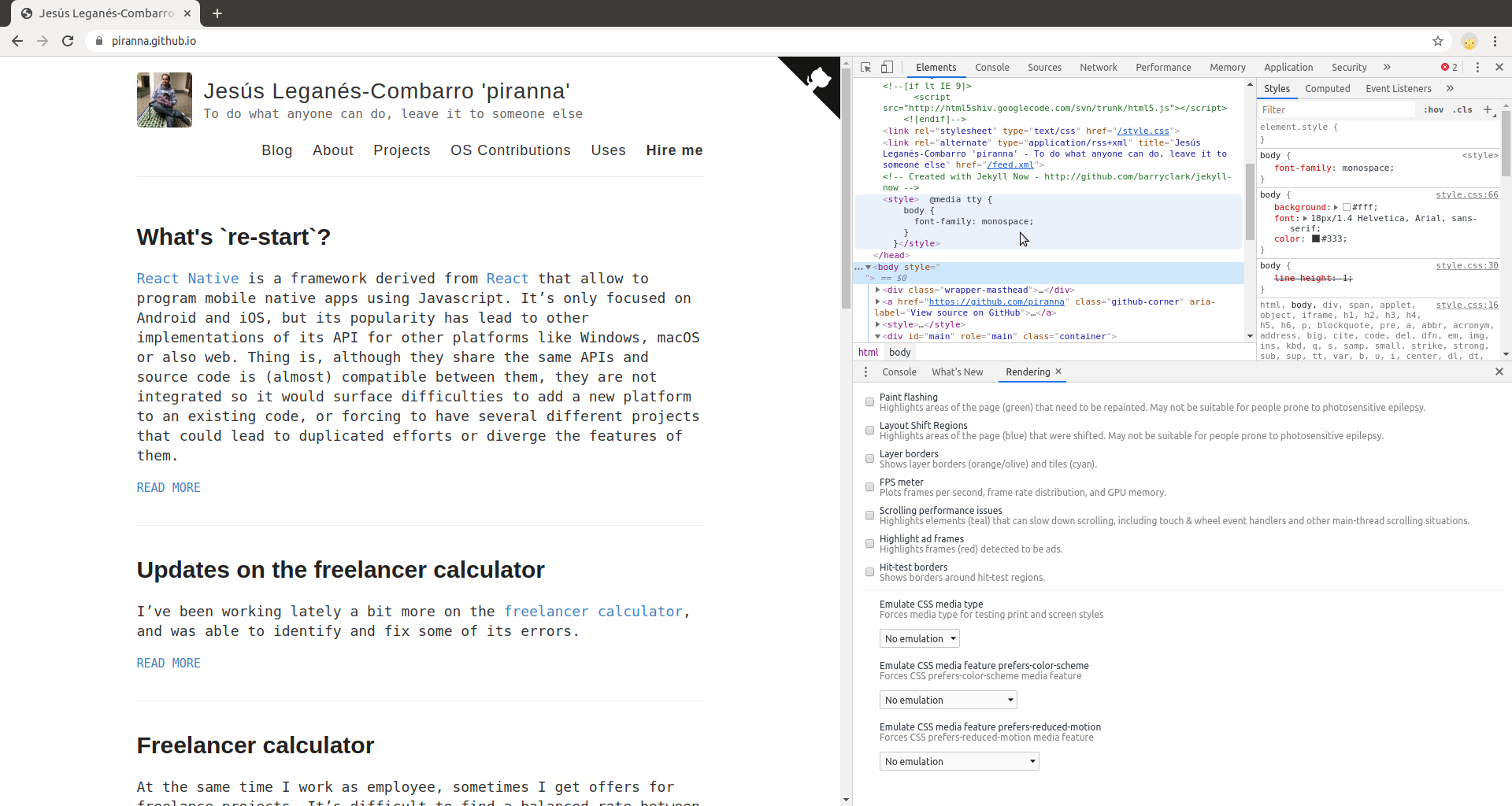
How to simulate Chrome is running in a TTY
I’ve always loved terminals and retro-computing. I find they were a technology that didn’t got fully their full potential due to graphical interfaces (it’s strange I say this since my first computer was a Macintosh LC II at a time where everybody else had at most a PC with Windows 3.11…). That’s the main reason I added support for Unicode BPM plain in Linux kernel for NodeOS, specially to have available the Braille patters used by blessed-contrib to draw graphical diagrams in the terminal. That’s the reason why when I discovered BOOTSTRA.386 project, a Bootstrap theme that mimics a text-mode interface in a website similar to old BBSs (fathers of web forums, and grandfathers of current online walls), I got enthusiastic about the idea of making it compatible with real terminal web browsers like Links, w3m or Lynx.