

Beyond the Browser: Running mediasoup-client in Node.js as a Headless WebRTC Endpoint
How mediasoup-client-wrtc turns Node.js into a first-class programmable mediasoup endpoint
Historical Background
mediasoup has long established itself as one of the most flexible Selective Forwarding Unit (SFU) implementations for building real-time communication systems. Its low-level architecture exposes media primitives rather than application concepts, allowing developers to build everything from videoconferencing systems to broadcasting platforms and custom media infrastructures.
On the client side, mediasoup-client provides the complementary abstraction that hides most of the complexity involved in negotiating WebRTC sessions with a mediasoup server. Browser applications simply instantiate a Device, negotiate transports, and produce or consume media.
React Native gained support years ago through its own platform-specific handler,
proving that mediasoup-client was never inherently tied to browsers. Instead,
it was designed around an abstraction layer capable of adapting to different
WebRTC implementations.
Node.js, however, remained an interesting gap. From the mediasoup-client documentation:
There is no native WebRTC or RTP engine in Node.js. When running in Node.js the application must provide mediasoup-client with a custom handler to control a 3rd party media/RTP library.
Although mediasoup itself runs on Node.js, there was no reusable implementation
capable of turning another Node.js process into a real mediasoup-client
endpoint.
That missing piece is precisely what mediasoup-client-wrtc implements.
Introduction
One of the most common misunderstandings when discussing mediasoup is the expression:
“Using mediasoup in Node.js.”
Strictly speaking, mediasoup has always run on Node.js. That is not the problem.
The missing piece has always been the other side of the connection:
How can a Node.js process behave as an actual WebRTC participant using the same abstractions as browser clients?
- Not as the SFU.
- Not through raw RTP.
- Not by bypassing mediasoup’s client-side abstractions.
- But as a genuine
mediasoup-clientendpoint capable of producing media, consuming streams, opening WebRTC DataChannels and participating in the complete WebRTC lifecycle.
This distinction is more important than it may initially appear.
Many backend integrations use RTP transports, FFmpeg or GStreamer, which are
perfectly valid solutions for media gateways, recording or transcoding. Those
approaches, however, operate outside the programming model offered by
mediasoup-client.
For many scenarios this is perfectly sufficient. For others, it is not.
Integration testing, synthetic participants, programmable bots, AI pipelines, server-side DataChannels or reusable media components often need to exercise exactly the same client-side logic used by browser applications.
The goal of this project is therefore not to replace mediasoup’s existing
server-side APIs. Instead, it enables Node.js applications to become
first-class mediasoup participants
by implementing the missing handler required by mediasoup-client.
The result is a reusable Open Source component that allows Node.js processes to join mediasoup applications exactly as any browser client would, while remaining completely independent from any particular signaling protocol or application architecture.
The Browser Is No Longer the Only Execution Environment
Historically, the execution model commonly associated with mediasoup-client
and other high-level
WebRTC APIs has
looked something like this:

This association is understandable. Most mediasoup applications are web applications, and browsers already provide complete WebRTC implementations. Over time, however, this mental model became stronger than the actual architecture.
mediasoup-client is designed so that its platform-dependent behavior is
isolated behind a HandlerInterface, responsible for translating mediasoup
operations into the native WebRTC APIs exposed by the underlying runtime. Once a
proper runtime handler exists, the architectural picture changes:

This shift is subtle, but important: it means that the application logic built
on top of mediasoup-client can potentially be reused across browsers, Node.js
services, automated tests and other execution environments, provided that each
runtime supplies a compatible handler.
That is precisely the role of mediasoup-client-wrtc.
The Missing mediasoup Endpoint
At this point it is useful to distinguish between two different layers that are often confused.
Most videoconferencing applications expose concepts such as:
- Rooms
- Participants
- Calls
- Meetings
- Sessions
Those concepts belong to the application.
mediasoup intentionally exposes lower-level media primitives instead:
- Workers
- Routers
- WebRtcTransports
- Producers
- Consumers
- DataProducers
- DataConsumers
This distinction is one of mediasoup’s greatest strengths.
The project does not introduce another WebRTC abstraction, the WebRTC API
already exists. Its purpose is to implement the runtime contract expected by
mediasoup-client, giving Node.js the same low-level endpoint capabilities as
browser clients while leaving application semantics entirely outside the
library.
Why This Is Not Already Trivial
At first glance, the problem may appear deceptively simple: Node.js already has
WebRTC implementations, and mediasoup-client already exists. Why not simply
instantiate a RTCPeerConnection and connect everything together?
The reality is considerably more complex.
mediasoup-client is deliberately designed around a platform abstraction known
as HandlerInterface, where each supported platform provides its own
implementation responsible for translating mediasoup operations into native
WebRTC primitives. That handler is responsible for much more than exposing a
RTCPeerConnection. It manages capability discovery, SDP negotiation, transport
creation, RTP parameter translation, SCTP negotiation, transceiver lifecycle,
statistics, ICE restarts, and other platform-specific details that allow
mediasoup-client to present a consistent programming model independently of
the underlying runtime. Without that layer, every Node.js project would need to
solve those problems independently.
There is another reason why this gap remained relatively unexplored: server-side
integrations traditionally rely on RTP transports, FFmpeg, GStreamer or similar
pipelines. Those solutions are excellent whenever the goal is media ingestion,
recording or transcoding, but they are less suitable when the objective is to
reproduce the complete behaviour of a WebRTC client, because they bypass the
client-side negotiation and media lifecycle managed by mediasoup-client.
Automated integration tests are a perfect example: testing the complete
lifecycle of producers, consumers, transports, DataChannels and media
negotiation requires speaking the same language as browser clients. That
language is mediasoup-client.
High-Level Architecture
The project intentionally keeps the public API extremely small: just a WebRTC
runtime is injected into the handler, which in turn is passed to
mediasoup-client as its platform implementation.
import * as wrtc from "@roamhq/wrtc";

import { Device } from "mediasoup-client";
import { WrtcHandler } from "mediasoup-client-wrtc";

const handlerFactory = WrtcHandler.createFactory(wrtc);

const device = new Device({
  handlerFactory,
});

await device.load({
  routerRtpCapabilities,
});
Internally, the handler bridges two fundamentally different models:
- mediasoup’s transport-oriented abstractions.
- the native WebRTC implementation exposed by the selected runtime.
The concrete WebRTC runtime is injected into the handler rather than imported by the library.
The complete architecture is illustrated below:

Notice that the application-level concepts intentionally do not appear anywhere
in this diagram. There are no rooms, participants or meetings. Everything above
the Device abstraction remains the application’s responsibility. The diagram
only contains mediasoup primitives.
That flexibility complements mediasoup’s already well-known performance characteristics.
Headless Browser vs Headless mediasoup Endpoint
When discussing automated testing of frontend libraries, browser automation is often the first solution that comes to mind. Headless browsers are incredibly valuable tools, but they solve a different problem: they are heavyweight end-to-end solutions.
mediasoup-client-wrtc, on the other hand, creates programmable mediasoup
endpoints that could be used as a lightweight alternative for automated
testing.
| Headless browser | Headless mediasoup endpoint |
|---|---|
| Browser automation | Native Node.js process |
| Requires a DOM | No DOM required |
| UI-oriented | Media-oriented |
| Heavyweight runtime | Lightweight Node.js application |
| Validates browser behaviour | Validates WebRTC and media behaviour |
| Full browser startup | Regular Node.js process |
This distinction has interesting architectural consequences: because the media logic no longer depends on rendering or browser-specific APIs, it naturally encourages a cleaner separation between transport logic and user interface.
The same signaling code, transport management and media lifecycle can now be reused across browsers, Node.js services and automated integration tests, while the UI remains free to focus exclusively on presentation.
This is not intended to replace browser testing. Browser-specific behaviour, permissions, rendering and DOM interactions still require browser automation.
Instead, it introduces an intermediate testing layer capable of exercising the complete mediasoup media lifecycle without requiring an actual browser.
Perhaps more importantly, it also encourages a healthier software architecture:
If your mediasoup client logic can only run inside a rendered browser page, your media architecture may be coupled too tightly to the UI.
A browser may be one deployment environment for a mediasoup client, but it should not have to define the architecture of the client itself.
Separating media orchestration from presentation improves reusability, testability, debugging and long-term maintainability, regardless of whether the final application runs inside a browser or not, and makes the same session and transport logic usable from browser applications, Node.js integration tests and backend participants.
Handler Architecture
Creating a Device only requires injecting a compatible WebRTC runtime and
passing the resulting handlerFactory to mediasoup-client. The simplicity of
this API hides a surprisingly complex implementation.
Unlike a browser, where mediasoup-client can rely on native platform
integration, Node.js requires the handler to implement the complete contract
expected by HandlerInterface. This means acting as the bridge between
mediasoup’s transport model and the WebRTC primitives exposed by the selected
runtime.
| Area | Supported operations |
|---|---|
| Transport | connect, restart ICE, update ICE servers |
| Sender | send, stop, pause/resume, replace track, encoding updates, stats |
| Receiver | receive, stop, pause/resume, stats |
| Data | send and receive negotiated SCTP DataChannels |
Internally, the handler is responsible for tasks such as:
- discovering the runtime’s native RTP capabilities
- creating and managing
RTCPeerConnectioninstances - negotiating ICE, DTLS and SCTP sessions
- translating mediasoup RTP parameters into SDP
- managing transceivers and MIDs
- creating Producers and Consumers
- creating DataProducers and DataConsumers
- handling ICE restarts
- replacing tracks
- updating RTP encodings
- and exposing sender and receiver statistics
The objective is not to expose another WebRTC API. Instead, it allows existing
mediasoup-client code to execute unchanged inside a Node.js process.
Bridging Two Different Models
One of the most interesting aspects of the implementation is that it does
not simply wrap RTCPeerConnection. Instead, it continuously translates
between two different programming models.
On one side, mediasoup-client operates with concepts such as:
- RTP capabilities
- Transport options
- RTP parameters
- SCTP parameters
- Producers
- Consumers
- DataProducers
- DataConsumers
On the other side, the WebRTC runtime understands a completely different set of abstractions:
RTCPeerConnection- SDP offers and answers
RTCRtpTransceiverRTCRtpSenderRTCRtpReceiverMediaStreamTrack- RTCDataChannel
The handler continuously translates between both worlds:

This translation layer is the actual value provided by mediasoup-client-wrtc.
Everything else is simply an implementation detail.
Discovering Native RTP Capabilities
Before a mediasoup Device can be loaded, it needs to know which codecs, RTP
header extensions and media capabilities are supported by the underlying WebRTC
implementation. Browsers already know how to obtain this information through
their native handlers. Node.js does not.
Instead of maintaining a static list of supported codecs, the handler queries
the runtime directly by creating a temporary RTCPeerConnection, adding
transceivers and generating a local SDP offer. The resulting SDP is then parsed
to build mediasoup’s native RTP capabilities:
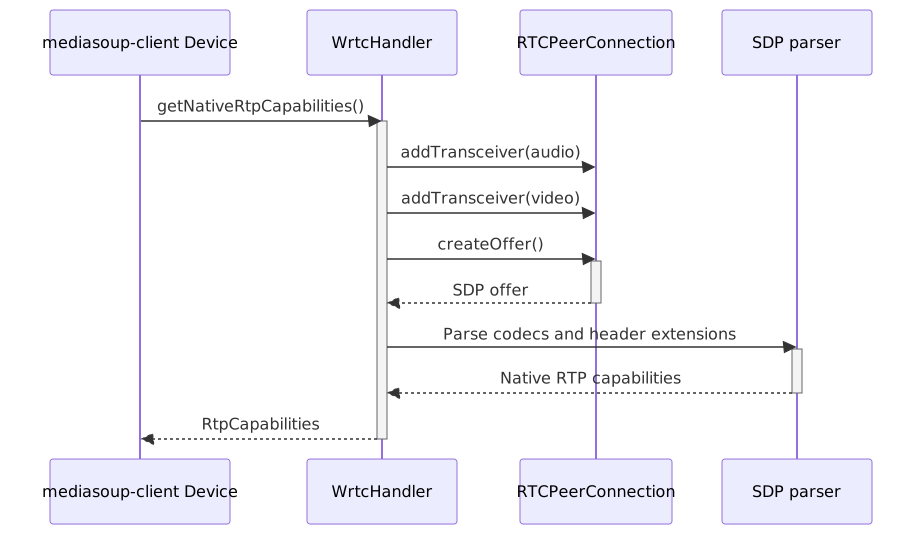
This approach has an important advantage: the handler does not need to know
anything about supported codecs in advance. Instead, it simply asks the runtime.
This avoids hardcoding codec capabilities and makes the design portable across
node-webrtc-compatible runtimes. Behavioral compatibility must still be
validated for each implementation and libwebrtc version.
Translating mediasoup Parameters into WebRTC
The opposite operation happens every time mediasoup creates a transport.
mediasoup exposes transport information using its own data structures:
- ICE parameters
- ICE candidates
- DTLS parameters
- RTP parameters
The WebRTC runtime, however, expects an SDP description.
The handler is therefore responsible for building an SDP representation from
mediasoup’s transport model before applying it to the underlying
RTCPeerConnection:

This translation happens transparently for the application.
From the perspective of the developer, though, transports are still created through the familiar mediasoup APIs.
Managing Transceivers Throughout Their Lifecycle
Negotiation is only the beginning. Once media starts flowing, the handler must maintain a persistent mapping between mediasoup entities and the corresponding WebRTC objects:

Keeping this mapping alive allows later operations such as:
- pausing Producers
- resuming Consumers
- replacing tracks
- updating encoding parameters
- gathering sender and receiver statistics
- or stopping transports cleanly
Without this bookkeeping, the connection could be established, but its lifecycle could not be managed correctly.
DataChannels Are First-Class Citizens
Media is not the only transport managed by the handler, SCTP DataChannels are negotiated through exactly the same infrastructure.
The handler creates the negotiated RTCDataChannel, exchanges SCTP parameters
with mediasoup and exposes the resulting DataProducer or DataConsumer
through the normal mediasoup-client APIs:
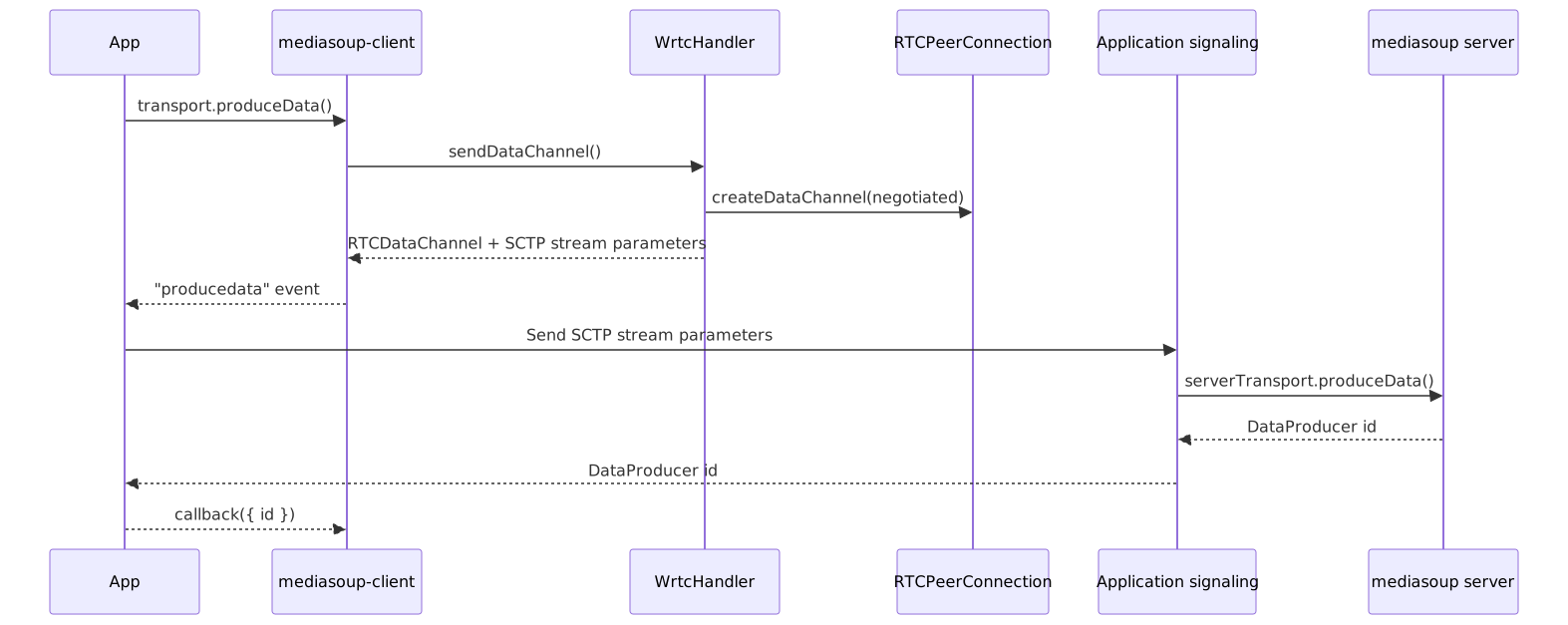
This becomes particularly interesting when combined with server-side participants: a Node.js process can now participate in exactly the same SCTP infrastructure as browser clients, opening the door to backend-controlled DataChannels, service-to-service communication and programmable media workflows.
Just to be clear: server-centered DataChannels should not automatically replace
WebSockets. I previously explored one possible application of this idea and its
trade-off in more detail in my article
Mediasoup DataChannels: When Replacing WebSockets Actually Makes Sense,
including the additional complexity that appears when SCTP is used as a generic
server-centered messaging layer, which also led to an interesting
community discussion.
The narrower point here is that mediasoup-client-wrtc makes the same
DataProducer and DataConsumer APIs available to Node.js participants.
Runtime Injection Instead of Runtime Lock-In
Although the examples in this article use @roamhq/wrtc, the project is intentionally not tied to a specific implementation. Instead, it targets the API family originally established by node-webrtc, allowing compatible implementations to be injected without changing the handler itself. So, the runtime is injected through a small factory:
interface WrtcLike {
  RTCPeerConnection: new (
    configuration?: RTCConfiguration,
  ) => RTCPeerConnection;

  MediaStream: new () => MediaStream;
}

const wrtc: WrtcLike = ...;

const handlerFactory = WrtcHandler.createFactory(wrtc);
The testing helpers (more on this later) require additional non-standard source and sink APIs, but the core handler is built around this smaller contract. This design keeps the project independent from any particular runtime, allowing consumers to select whichever one best fits their platform:

Public API
Until the package is published on npm, it can be installed directly from the repository:
npm install github:piranna/Mediasoup-client-wrtc mediasoup-client @roamhq/wrtc
The public API intentionally remains extremely small, it requires little more than injecting the desired runtime:
import { WrtcHandler } from "mediasoup-client-wrtc";

const handlerFactory = WrtcHandler.createFactory(wrtc, loggerSink);
It’s also possible to add a loggerSink argument to the factory, which will
receive all internal debug logs from the handler. This is useful for debugging
and understanding the internal state of the handler during development or
testing. When omitted, the logger sink defaults to console.
For automated testing, the project also exposes a separate testing entrypoint
containing reusable helpers for creating synthetic media sources and inspecting
received media without cluttering the main API surface:
import {
  createSyntheticAudioTrack,
  createAudioSink,
  createWrtcDevice,
} from "mediasoup-client-wrtc/testing";
Keeping the testing utilities behind a separate subpath keeps the core API
focused while providing practical building blocks for integration tests and
examples. These helpers depend on the non-standard source and sink APIs commonly
provided by the node-webrtc runtime family.
One of the design goals of the project was to expose the smallest possible API surface. Most of the complexity belongs inside the handler, not in user code. From the application’s perspective, the resulting programming model remains identical to every other mediasoup client. There are no new abstractions to learn:
- No custom transport layer.
- No proprietary signaling protocol.
- No mediasoup-specific wrapper replacing
Device.
Existing mediasoup applications gain a new runtime without adopting a new client abstraction.
End-to-End Media, Not Just API Compatibility
Successfully constructing a Device proves that the handler can expose RTP
capabilities to mediasoup-client.
It does not yet prove that media can travel through a complete WebRTC pipeline.
A useful Node.js endpoint must be able to do much more:
- create a
mediasoup-clientDevice - negotiate a sending
WebRtcTransport - produce a real
MediaStreamTrack - transmit encoded media over ICE, DTLS and SRTP
- route that media through mediasoup
- negotiate a receiving transport
- create a Consumer
- receive and decode the media through another WebRTC endpoint
- and expose the resulting frames to application code
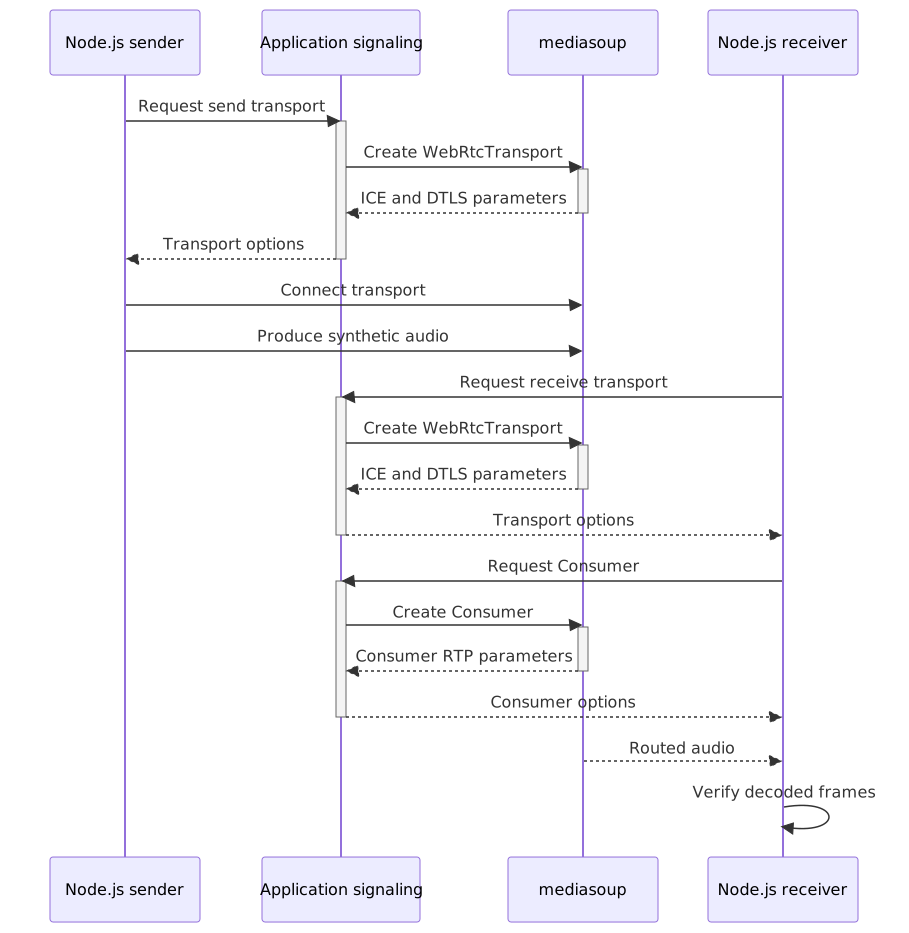
mediasoup-client-wrtc includes a complete example exercising that path with
two independent Node.js clients and a real local mediasoup Worker. They run in
the same process for convenience, but they use independent Devices,
PeerConnections and WebRTC transports. Nothing in the handler requires the
endpoints or mediasoup server to share a process:

The sender creates a synthetic audio track through the non-standard media-source
API exposed by the selected node-webrtc-compatible runtime:
const source = new wrtc.nonstandard.RTCAudioSource();
const track = source.createTrack();
That track is passed to the normal mediasoup-client transport API:
const producer = await sendTransport.produce({ track });
At the receiving endpoint, the Consumer exposes a regular MediaStreamTrack.
The runtime can attach an audio sink to that track and inspect the decoded PCM
frames:
const sink = new wrtc.nonstandard.RTCAudioSink(consumer.track);

sink.ondata = (frame) => {
  framesReceived++;
};
The source and sink APIs are not part of the WebRTC browser standard. They are
extensions shared by the node-webrtc family of runtimes, designed precisely
for programmable media generation and inspection.
Everything between them, however, is a real WebRTC pipeline:

This distinction matters.
A mocked RTCPeerConnection can validate method calls and state transitions. A
mocked mediasoup server can validate signaling orchestration. Neither proves
that media actually survives a complete WebRTC exchange.
The real example exercises:
- native RTP capability detection
- ICE negotiation
- DTLS establishment
- SRTP transmission
- Opus encoding and decoding
- mediasoup routing
- Producer and Consumer creation
- track delivery
- and decoded audio-frame reception
The example currently verifies that decoded frames arrive at the destination. Later in this article, I will describe how this can be extended to validate not only the presence of media, but also its actual content and quality. This is end-to-end at the media-transport level, not at the application level: the example uses local orchestration rather than a product-specific signaling server.
Node.js as a First-Class mediasoup Participant
Testing was the original motivation for the project, but it is not the boundary
of what the handler enables. Once Node.js can execute mediasoup-client through
a real WebRTC runtime, it can become a programmable participant in any
mediasoup-based system:

The important word is participant.
A Node.js process is not limited to controlling the mediasoup server or
injecting raw RTP into a PlainTransport. It can now behave like the client
side of the system:
- loading Router RTP capabilities
- creating sending and receiving transports
- producing and consuming tracks
- opening DataChannels
- reacting to transport state changes
- replacing tracks
- pausing and resuming media
- collecting sender and receiver statistics
- and restarting ICE when needed
This makes Node.js suitable for workloads that need the full WebRTC endpoint lifecycle rather than only access to RTP packets.
It also allows applications to reuse the same client-side abstractions across multiple environments:

The signaling protocol will still be application-specific.
mediasoup-client-wrtc does not attempt to define rooms, participants,
authentication or orchestration.
Instead, it provides the missing low-level endpoint implementation required to make those higher-level client abstractions reusable in Node.js.
Integration Testing Without a Browser
A mediasoup server can be thoroughly unit-tested while still failing when confronted with a real client.
Unit tests are excellent for validating isolated server behavior:
- Router and transport creation
- Producer and Consumer registries
- authorization
- signaling requests
- state transitions
- error handling
- and application-level coordination
But many failures only appear when those components interact with an actual WebRTC implementation. Examples include:
- invalid or incomplete DTLS parameters
- mismatched RTP capabilities
- incorrect codec negotiation
- broken header-extension mapping
- Consumer resume errors
- transport direction mistakes
- malformed SCTP parameters
- incorrect lifecycle ordering
- or regressions in ICE restart handling
A Node.js mediasoup endpoint provides a useful testing layer between server unit tests and full browser automation:

Each layer answers a different question:
| Test layer | Main question |
|---|---|
| Server unit tests | Does each server component behave correctly in isolation? |
| Node.js WebRTC integration tests | Can a real mediasoup client negotiate and exchange media with the system? |
| Browser end-to-end tests | Does the complete user-facing application work in a particular browser? |
mediasoup-client-wrtc does not make Playwright, Puppeteer or browser-based
testing (end-to-end tests) obsolete. Instead, it provides a more focused layer
for tests where the subject is the mediasoup and WebRTC behavior rather than the
UI. A typical test scenario can create two programmable endpoints:
Also, this can run against:
- a locally running development server
- a media service inside Docker
- an ephemeral CI environment
- a staging deployment
- or a remote integration environment
Just like integration tests, the test does not need to know how the server process was started, only that it did. It only needs access to the same signaling interface used by actual clients.
That separation is desirable: an integration test should validate the externally observable behavior of the media system, not become coupled to the implementation details of the server bootstrap process.
Running client logic directly in Node.js also encourages signaling, transport management and media lifecycle code to remain outside DOM components. These components can then be tested independently from rendering, improving:
- modularity
- code reuse
- debugging
- observability
- portability
- and maintainability
Programmable Media Bots
A media bot is simply a participant whose tracks are controlled by software instead of a human-operated microphone or camera.
Once Node.js can create and consume mediasoup tracks, many bot-oriented use cases become straightforward.
Audio playback bots
A Node.js process can generate or decode PCM audio, push it into an
RTCAudioSource, and publish the resulting track as a regular mediasoup
Producer. Possible sources include:
- WAV files
- generated tones
- text-to-speech output
- music
- announcements
- prerecorded prompts
- or dynamically generated audio

From the perspective of the mediasoup server and the remote Consumers, this is an ordinary audio Producer. Whether the application presents the bot differently from a human participant remains an application-level decision.
Video generation
The same model applies to video through compatible runtime extensions such as
RTCVideoSource. A programmable endpoint can produce:
- synthetic frames
- generated overlays
- image sequences
- rendered dashboards
- virtual participants
- test patterns
- or preprocessed frames from an external pipeline
Monitoring and recording bots
A Node.js endpoint can also act as a Consumer. Decoded audio or video can be inspected, recorded or forwarded to another processing system:

This is not necessarily the most efficient architecture for every recording
system. A PlainTransport and direct RTP processing may be preferable when
WebRTC endpoint semantics are unnecessary.
The Node.js client approach becomes especially valuable when the bot must behave like a real participant, share client-side code, exercise WebRTC negotiation, or interact through both media and DataChannels. That is where the deliberately generic endpoint model pays off.
AI Media Services as Real Participants
AI-powered media services are a particularly natural fit for programmable WebRTC endpoints.
Many current real-time AI architectures need to:
- receive live audio;
- decode it to PCM;
- process it through speech recognition or another model;
- generate a response;
- synthesize new audio;
- publish that audio back into the session.

Using a Node.js mediasoup-client endpoint allows the AI service to participate
through the same WebRTC model as the other clients. The service can:
- consume selected Producers
- publish one or more generated tracks
- pause or resume dynamically
- replace tracks
- collect WebRTC statistics
- exchange metadata through DataChannels
- react to transport failures
- and reconnect through the same client lifecycle
This can be useful for:
- conversational voice agents
- live transcription
- translation
- meeting assistants
- moderation systems
- audio classification
- sentiment or event detection
- or real-time media transformation
Again, raw RTP may be the better choice for some high-throughput processing pipelines. The advantage here is not that WebRTC should replace every backend media protocol. The advantage is that a service can become an actual client whenever endpoint semantics are useful. That distinction gives architects another option rather than forcing every backend integration through the same transport model.
Media Bridges and Processing Pipelines
A programmable Node.js endpoint can also bridge mediasoup with external media systems.
The outgoing side may consume data from:
- FFmpeg
- GStreamer
- a file decoder
- a hardware source
- another network transport
- or a custom DSP pipeline
The incoming side may deliver decoded media to the same kinds of systems.

The project intentionally does not implement those adapters. Its responsibility
ends at the runtime’s MediaStreamTrack boundary.
That is important because media ingestion and processing requirements vary enormously between applications. By keeping the handler generic, the application remains free to connect the WebRTC tracks to whichever media pipeline it needs.
DataChannels From Node.js
Audio and video are only part of the endpoint model.
Because mediasoup-client-wrtc also implements SCTP DataChannel support,
Node.js services can create DataProducer and DataConsumer instances using
the same APIs as browser clients:

The direction can naturally be reversed:

This enables backend participants to exchange:
- synchronized metadata
- control commands
- telemetry
- reactions
- moderation events
- AI-agent state
- media-processing results
- server-to-server coordination
- and application-specific protocol messages
The relevance here is narrower: when a Node.js process already participates in the mediasoup session, DataChannels become another first-class capability of that endpoint, and the same Node.js service can consume audio, produce generated speech and exchange synchronized control data through one coherent client model:

This is particularly useful when data semantics are directly tied to the media session. For example, an AI transcription service might publish partial transcripts, word timings, or confidence values through a DataProducer while consuming the corresponding audio track.
From Frame Delivery to Deterministic Media Validation
The current real-media example verifies that decoded audio frames arrive at the receiving endpoint. That is already enough to prove that the complete path is operational. But receiving frames does not necessarily mean receiving the correct media, a broken pipeline might still produce frames while introducing:
- severe distortion
- silence
- unexpected resampling
- dropped segments
- timing errors
- codec configuration mistakes
- channel-layout problems
- corrupted or substituted content
The logical next step is to validate the information carried by those frames. This connects directly with my previous work on audio-test-fixtures, a deterministic, FFT-based methodology for verifying that known audio content survives lossy and time-sensitive media pipelines through known tone sequences and spectral analysis. The principle is straightforward:
- generate a deterministic audio fixture
- inject it into the sending WebRTC endpoint
- transmit it through mediasoup
- capture the decoded PCM at the receiving endpoint
- analyze the result
- and compare it against known spectral expectations

Unlike waveform equality, spectral validation can tolerate many changes that are normal in real media systems:
- lossy encoding
- small phase shifts
- gain changes
- minor timing drift
- codec artifacts
The test can ask a more meaningful question:
Did the expected audio information survive the complete end-to-end pipeline within an acceptable tolerance?
A deterministic fixture could contain a known sequence of tones, for example across the vocal range. The validator would detect the dominant frequency in each expected segment and calculate metrics such as:
- detected frequency
- frequency error
- percentage of correct tones
- missing segments
- signal-to-noise ratio
- timing deviation
- distortion
- and regressions caused by codec or transport changes
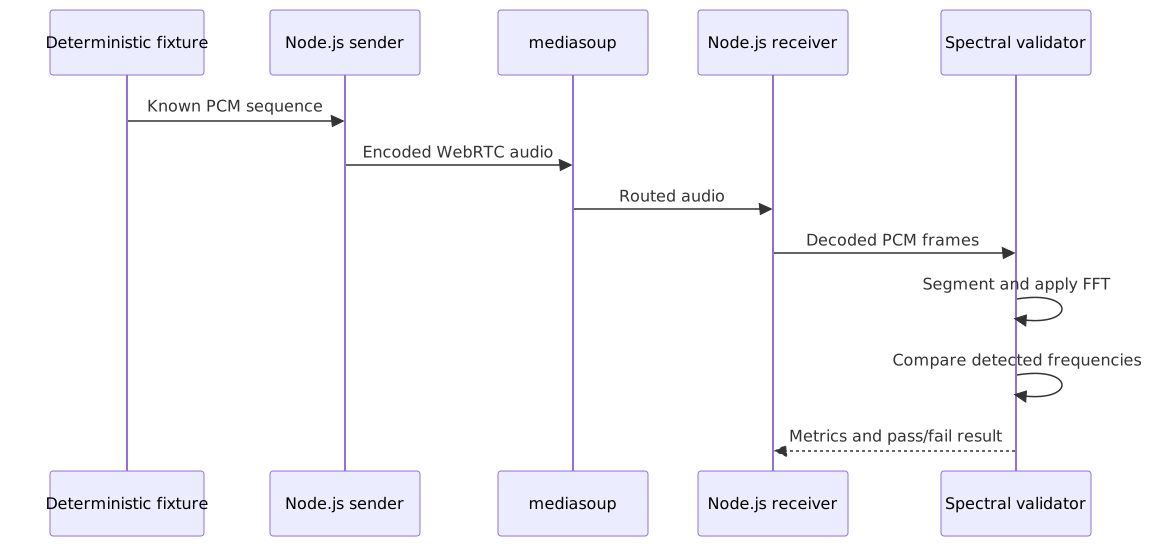
This would provide a real content-aware integration test:
- Not only:
“Did the Consumer receive frames?”
- But:
“Did the correct audio survive encoding, transport, routing and decoding?”
My existing deterministic fixture tooling currently works with WAV files rather
than live Node.js tracks. It has not yet been ported or integrated with
mediasoup-client-wrtc, and that work remains a future step. A native
TypeScript implementation and support for live streams (not only fixed audio
fixtures) remain possible follow-up work.
A complete implementation would need to bridge two forms of data, reference WAV files and live PCM frames, but the principle is straightforward:

The existing audio-test-fixtures implementation is written in Python, so
integration could initially be achieved without a full port by:
- generating or loading a pre-generated deterministic WAV fixture
- streaming its PCM samples into
RTCAudioSource - capturing decoded PCM through
RTCAudioSink - writing the result to WAV
- and invoking the existing validator
A native TypeScript implementation could follow later if live streaming analysis or tighter Node.js integration becomes useful. Another alternative would be to expose the validator as a separate process or service.
The final architecture is less important than the testing principle:
mediasoup-client-wrtc provides control over both endpoints of the WebRTC
exchange. Deterministic fixtures provide known media content and objective
validation. Together, they would enable repeatable end-to-end tests covering the
complete media path:

This is where programmable endpoints become especially valuable: a browser-based test can play and record media, but doing so reliably often requires permissions, virtual devices, browser flags and additional operating-system configuration. On the other hand, a Node.js endpoint can directly create the source, inspect the sink and expose every frame to the test harness.
The result is a test environment that is:
- deterministic
- automatable
- observable
- independent from physical devices
- suitable for CI
- and capable of validating actual media content
At that point, mediasoup integration testing stops being limited to control-plane assertions: it can validate the media plane itself.
Why Release It as Open Source?
mediasoup-client-wrtc originated from a practical need for a production
mediasoup service: creating real integration tests for a mediasoup-based service
without depending on browser automation. The original use case required many
media integration scenarios, and launching a full browser for every participant
would have made the test suite slower and more expensive.
The immediate requirement was specific, but the resulting implementation was not.
The handler contains no product-specific signaling protocol, room model,
authentication mechanism, deployment assumptions or business logic. It does not
know what a meeting, call or participant means to the application using it. Its
responsibility is limited to adapting mediasoup-client to a compatible WebRTC
runtime running in Node.js.
That makes it infrastructure.
Keeping such a component private would provide little competitive value while forcing other teams facing the same problem to rediscover and maintain the same translation layer independently. The reusable part is precisely the part that belongs in the open:
- the
HandlerInterfaceimplementation - runtime injection
- RTP capability discovery
- SDP and transceiver management
- sending and receiving media
- SCTP DataChannel support
- track lifecycle operations
- statistics and ICE management
- and synthetic source and sink helpers for testing
Application-specific signaling remains outside the library, where it belongs.

Publishing the handler as Free Software also provides advantages that go beyond code reuse. It allows other developers to:
- inspect the implementation
- validate its assumptions
- test it with different WebRTC runtimes
- report compatibility problems
- contribute missing functionality
- or build integrations that the original use case never anticipated
That external validation is particularly valuable for a compatibility layer: a handler can achieve complete coverage against its own tests and still encounter behaviour differences between runtime implementations, libwebrtc versions, operating systems or real mediasoup deployments. On the other hand, open development increases the number and diversity of environments in which those assumptions can be exercised.
The project is therefore not Open Source merely because the code happens to be generic: it is Open Source because openness is part of how a runtime adapter becomes trustworthy. Reports from other runtimes, platforms and real mediasoup integrations are especially valuable.
Design Philosophy
The project follows a small set of principles.
- Keep the mediasoup-client programming model intact.
- Treat Node.js as a first-class endpoint runtime.
- Inject WebRTC implementations instead of hardcoding one.
- Separate media and transport logic from the UI.
- Keep application signaling outside the library.
- Expose generic testing primitives without turning the core into a test framework.
Preserve the mediasoup-client abstraction
As explained in the High-Level Architecture section,
the project does not introduce a parallel client API. Applications still create
a Device, load Router RTP capabilities, create transports and produce or
consume media using the normal mediasoup-client methods.
This matters because the value of the project is not a new abstraction placed on
top of mediasoup. The value is making an existing, mature abstraction available
in another runtime. Code designed around mediasoup-client doesn’t need to be
rewritten merely because the endpoint happens to execute in Node.js rather than
a browser.
Keep runtime dependencies injectable
The handler receives its WebRTC implementation at runtime. It does not import
@roamhq/wrtc, node-webrtc or another native runtime internally. This allows
the consumer to choose:
- which native module to install
- which libwebrtc version to depend upon
- which platforms must be supported
- or which maintenance and release policy is acceptable
Separate media orchestration from presentation
Transport setup, signaling, device management and track lifecycle should remain outside UI components. Keeping these responsibilities separate makes the same client core reusable from browser interfaces, integration tests and backend services.
The UI may request that a microphone be published or muted, but it should not own the mechanics of transport negotiation.
Avoid application-level assumptions
mediasoup intentionally provides low-level media primitives.
mediasoup-client-wrtc follows the same philosophy.
Application semantics such as rooms, participants, permissions and reconnection policies remain intentionally outside the package. They vary between products; including them would turn a generic runtime handler into an opinionated application framework. Instead, the package provides the programmable endpoint on which those abstractions can be built.
Keep the core and testing utilities distinct
As explained in Public API, the main package export exposes the handler, and testing and integration helpers are available through a separate subpath. This distinction prevents the public handler API from becoming cluttered with convenience functions while still providing practical tools for examples and automated tests.
The testing helpers are useful, but they are not the identity of the project; the handler is. Testing is one of the things it enables.
Current Limitations
mediasoup-client-wrtc already implements a broad portion of the
mediasoup-client handler contract, including send and receive transports,
audio and video tracks, DataChannels, track replacement, pause and resume
operations, ICE restarts and statistics. It also includes automated tests and a
real-media example using a local mediasoup Worker and two Node.js endpoints.
It is nevertheless an early project. Understanding its current boundaries is important.
Runtime compatibility still needs broader validation
The handler is designed around the API family established by node-webrtc and
shared by several compatible forks. That compatibility model is practical, but
structural similarity does not guarantee identical behavior.
Different runtimes may depend on different:
- libwebrtc revisions
- native build systems
- operating-system integrations
- supported architectures
- non-standard media APIs
- SDP behavior
- or shutdown semantics
The examples currently use @roamhq/wrtc, but the injection model is
specifically intended to support other compatible implementations. Validating
that portability requires real testing against multiple runtimes.
Some media APIs are intentionally non-standard
The core WebRTC surface includes familiar APIs such as:
RTCPeerConnectionMediaStreamMediaStreamTrackRTCRtpSenderRTCRtpReceiver- and
RTCDataChannel
Programmable media generation and inspection, however, rely on extensions
commonly exposed by the node-webrtc family:
RTCAudioSourceRTCAudioSinkRTCVideoSourceRTCVideoSink
These extensions are extremely useful for bots, tests and media-processing
services, but they are not browser Web standards. The handler itself does not
require all of them merely to create a Device. Specific applications and
testing helpers may.
It does not provide signaling
mediasoup-client-wrtc deliberately does not define how a client communicates
with the application server. Every mediasoup application must still implement
signaling for operations such as:
- obtaining Router RTP capabilities
- creating transports
- connecting DTLS
- creating Producers
- requesting Consumers
- creating DataProducers and DataConsumers
- or handling application state
That signaling may use:
- WebSockets
- HTTP
- RPC
- DataChannels after bootstrap
- or a custom protocol
The library remains independent from that choice. This means that using
mediasoup-client-wrtc is not a one-line replacement for a complete application
client. This separation is intentional: the package provides the WebRTC endpoint
layer on which application-specific signaling and session logic operate.
It does not replace browser testing
Browser-specific behavior such as permissions, rendering and UI interactions still requires browser automation.
It is not always preferable to raw RTP
A full WebRTC endpoint introduces:
- ICE
- DTLS
- SRTP
- SDP negotiation
- transceivers
- and client lifecycle management
For recording, transcoding, broadcasting or high-throughput server-side
processing, a PlainTransport, FFmpeg, GStreamer or direct RTP integration may
be simpler and more efficient. mediasoup-client-wrtc is most useful when the
process needs client semantics:
- the same negotiation path as browser participants
- a
mediasoup-clientDevice - WebRTC transport behavior
- DataChannels
- reusable client logic
- realistic integration tests
- or dynamic track lifecycle
It adds another option for workloads that need endpoint semantics; it does not invalidate simpler RTP-based integrations.
Deterministic content validation is not implemented yet
The current end-to-end example verifies that decoded frames arrive. It does not yet validate that their content matches the transmitted signal.
The planned integration with deterministic audio fixtures remains future work and may live in a separate companion project. Until then, the example proves transport and decoding functionality, but not spectral fidelity or media quality.
It is not yet published on npm
The source is publicly available and can be installed directly from the repository, but the package has not yet been published to the npm registry.
Publishing it should be straightforward, but the release should include:
- a deliberate initial version
- validated package exports
- generated declaration files
- installation documentation
- runtime compatibility notes
- a minimal changelog
- and a clear stability statement
The current automated test suite reports full coverage for the code paths it exercises, providing a strong basis for an initial public release.
However, code coverage alone does not define API stability. A stable 1.0.0
release should ideally follow validation across several compatible runtimes and
external integrations. An initial 0.1.0 release would communicate that the
software is usable while leaving room to refine the public contract based on
ecosystem feedback.
Future Work
The current implementation establishes the essential foundation: Node.js can
execute mediasoup-client as a genuine WebRTC endpoint. Several logical next
steps follow from that foundation.
Publish an initial npm release
The most immediate step is making installation independent from GitHub:
npm install mediasoup-client-wrtc
A registry release would improve:
- discoverability
- dependency management
- reproducible installation
- semantic versioning
- and integration with automated tooling
The WebRTC runtime should remain a separately installed dependency so applications retain control over the native implementation they use.
Validate multiple WebRTC runtimes
Runtime injection only becomes fully valuable when compatibility is verified in
practice. The current examples are validated with @roamhq/wrtc. Additional
compatible runtimes will be added to a public compatibility matrix as they are
tested. This would identify whether adaptations are needed for differences
hidden behind superficially compatible APIs.
Expand real-media testing
The current real-server example focuses on audio delivery. The handler implements video operations, although the repository does not yet include a real-video integration example equivalent to the audio example. Future scenarios could cover:
- video production and consumption
- simulcast
- SVC
- spatial-layer changes
- track replacement
- pause and resume behavior
- ICE restart
- network interruptions
- transport closure
- multiple Producers and Consumers
- negotiated DataChannels
- or sustained media exchange
These should remain integration examples rather than reimplementing a complete mediasoup application.
Integrate deterministic audio fixtures
Complete the content-aware validation pipeline described above by streaming the existing deterministic WAV fixture into RTCAudioSource, capturing the decoded PCM from RTCAudioSink, and running the existing Python spectral validator. A native TypeScript port can be considered later.
Add reusable media adapters
The handler intentionally stops at the MediaStreamTrack boundary, but
companion packages or examples could demonstrate adapters for:
- WAV files
- FFmpeg
- GStreamer
- Node.js streams
- speech-to-text services
- text-to-speech services
- hardware sources
- or custom DSP pipelines
These should remain optional and modular. There is no universal media-pipeline abstraction that fits every application.
Explore server-side DataChannel participants
The handler already supports negotiated SCTP DataChannels, but I can add complete examples combining media and DataChannels in the same programmable endpoint, including synchronized transcription metadata and backend control channels.
Improve diagnostics and observability
Programmable endpoints are valuable debugging tools. Future helpers could expose:
- structured transport-state logs
- periodic
getStats()snapshots - ICE and DTLS timing
- packet-loss metrics
- jitter and round-trip time
- Producer and Consumer lifecycle traces
- or machine-readable reports for CI
The existing logger injection already provides a foundation for integrating diagnostics with an application’s logging stack.
Archive versioned releases
Once the first release is ready, GitHub releases could be archived through Zenodo. That would provide:
- a permanent DOI for each release
- a conceptual DOI for the project
- citable historical versions
- and reproducible references from technical articles
The project can continue evolving normally. Each archived release would represent a stable snapshot rather than freezing future development.
What This Project Changes
The broader significance of the implementation comes from the model it enables:

The browser is one possible execution environment for that model. Node.js can now become another, enabling programmable endpoints such as automated tests, media bots, AI services and media bridges.
Services that need WebRTC endpoint semantics no longer need to pretend to be browsers.
Final Thoughts
mediasoup-client-wrtc started from a testing problem. The requirement was
simple to state:
Run real mediasoup integration tests from Node.js without launching a browser.
Solving it required addressing a more fundamental question:
How can a Node.js process use mediasoup not as the server, but as an actual WebRTC participant?
The answer was not another signaling framework, a simulated client or a thin
wrapper around RTCPeerConnection: it was a complete mediasoup-client handler
capable of translating between mediasoup’s client model and a programmable
WebRTC runtime. That translation makes Node.js a first-class execution
environment for mediasoup-client.
But the most important result is architectural:
The goal is not to bring mediasoup to Node.js. mediasoup has always run there.
The goal is to bring mediasoup-client to Node.js.
The browser is no longer the only execution environment for mediasoup-client,
and launching a headless browser is no longer the only way to create a headless
mediasoup endpoint: the browser becomes just one endpoint among many.
Browsers made WebRTC ubiquitous. Programmable endpoints make it composable.